

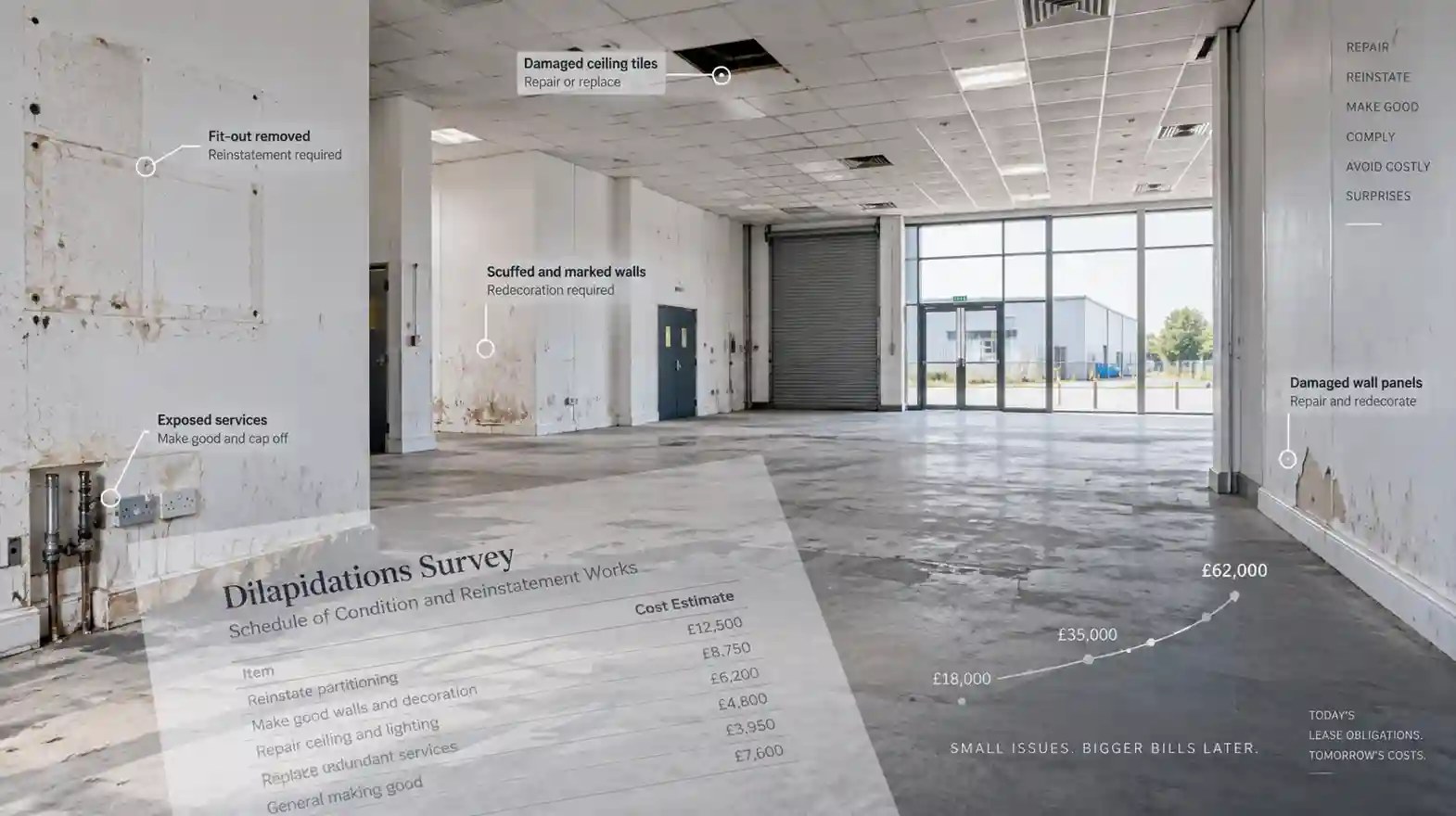
A business hands back a warehouse or office it has occupied for eight years, having paid the rent every quarter, and receives a schedule of dilapidations setting out a substantial programme of repair, decoration and reinstatement. The instinctive reaction is that something has gone wrong at the end of the lease. Very often, the more important decisions were made at the beginning.
The repairing covenant may have been accepted without a proper assessment of the building’s existing condition. Alterations may have been installed without thinking through the eventual reinstatement obligation. A schedule of condition may never have been prepared, or may have existed without the lease wording needed to give it the protection the tenant assumed it provided. Years later, those decisions reappear as an end-of-term liability.
That is why dilapidations are better understood as a lease-lifecycle risk than as a bill that suddenly materialises when the keys are handed back.
The legal and procedural discussion below principally concerns commercial property in England and Wales. Scotland and Northern Ireland have different legal frameworks and should not be assumed to follow the same rules.
The liability starts with the lease, not the dilapidations schedule
The schedule served towards the end of the tenancy does not create the tenant’s repairing obligations. It identifies alleged breaches of obligations that already exist under the lease and related documents, which is why the condition of the premises and the wording agreed at commencement matter so much.
A tenant taking tired premises can still accept a repairing covenant that requires considerably more than simply preventing further deterioration. A covenant to “keep” premises in repair can, depending on its wording and context, require existing disrepair to be remedied before the property can then be kept in the required condition. The fact that a defect existed before the tenant arrived does not necessarily mean responsibility for it remains with the landlord.
The phrase “full repairing and insuring lease”, or FRI, is often used as shorthand in the market, but it should not be treated as though it carries one automatic legal meaning. It generally indicates that the tenant bears the economic responsibility for repair and insurance, directly or through the lease structure, but the real exposure depends on the wording of the repairing covenant, the definition of the premises, any exclusions or qualifications and the associated lease documents.
A schedule of condition can therefore be extremely valuable, but only if it is doing more than recording what the building looked like. Photographs and written descriptions provide evidence of condition; they do not necessarily alter the repairing covenant by themselves. If the commercial bargain is that the tenant should not have to return the premises in any better condition than they were in at commencement, the lease needs to express that limitation and tie it properly to the agreed schedule.
That also means the quality of the schedule matters. A handful of wide-angle photographs may show that a warehouse looked tired, but not establish the detailed condition of flooring, cladding, roofing, services, corrosion or individual defects that later become disputed. The RICS Dilapidations in England and Wales professional standard provides the professional framework for this work and emphasises the importance of understanding repairing obligations and the evidential position properly.
There is a further complication for a business acquiring an existing lease rather than taking a new one. The relevant benchmark may not simply be the condition in which the incoming occupier receives the premises. Depending on the lease and the documentation already in place, the liability can trace back to obligations assumed much earlier in the term. Dilapidations due diligence therefore belongs alongside rent, term and break analysis when a leasehold interest is being acquired.
Repair is only one part of the exposure
It is easy to use “dilapidations” as shorthand for repair, but an end-of-lease claim can bring together several different obligations.
Decoration may sit on its own contractual timetable, sometimes requiring internal or external works periodically during the term as well as at expiry. Across a substantial office, industrial building or retail unit, that can become a material cost rather than a cosmetic exercise.
Alterations create a different exposure again. A tenant may have spent heavily improving the premises for its own operation — installing partitions, mezzanines, signage, plant, cabling or specialist equipment — only to discover that the lease or licence for alterations requires some or all of those works to be removed at the end of the term.
Whether the alterations improved the building commercially does not necessarily answer the contractual question. The landlord may have required reinstatement regardless, which is why licences for alterations should be retained and understood during the tenancy rather than rediscovered shortly before expiry.
The distinction between repair, decoration and reinstatement becomes particularly important once a financial claim is made. Section 18 of the Landlord and Tenant Act 1927 can limit damages for breaches of repairing covenants, but it does not simply apply as a universal cap across every item appearing in a dilapidations claim. Separate obligations such as decoration, removal and reinstatement can require different analysis.
A single headline figure can therefore conceal liabilities arising under different provisions and measured according to different principles.
From a schedule of works to a recoverable financial claim
This is where one of the most important distinctions in dilapidations arises. A schedule of dilapidations identifies the landlord’s case: the relevant lease obligation, the alleged breach, the remedial work said to be required and, often, an estimated cost. It is not automatically an agreed debt, nor is the cost of carrying out every item necessarily the amount the landlord is ultimately entitled to recover.
In England and Wales, terminal claims are governed by the Ministry of Justice’s Dilapidations Protocol. It envisages a schedule normally being served within a reasonable period after termination, generally within 56 days, followed by a Quantified Demand explaining and substantiating the monetary claim. The tenant’s Response is also generally expected within a reasonable period, normally 56 days after the demand.
The terminology is important because the schedule and the financial loss are not the same thing. The Quantified Demand is intended to reflect the landlord’s likely loss, which may differ from the raw cost of the remedial works. The Protocol also requires the landlord’s intentions for the property to be considered when quantifying that loss.
For repair covenant claims, section 18(1) of the Landlord and Tenant Act 1927 is central. Its first limb limits damages to the amount by which the landlord’s reversionary interest has actually been reduced in value by the disrepair. Its second limb prevents recovery for relevant repair breaches where, at or shortly after termination, the premises would be demolished or structurally altered in a way that would render the repairs valueless.
Suppose the estimated cost of repairing alleged breaches is £200,000 but the disrepair has reduced the value of the landlord’s interest by only £80,000. For repair damages caught by section 18, that difference can be decisive. It does not mean tenants can simply apply a percentage discount to every claim: establishing diminution in value may require specialist valuation evidence, and other heads of claim such as reinstatement or decoration need to be considered separately.
The landlord’s actual plans can matter for the same reason. If it genuinely intends to demolish the property, substantially reconfigure it or carry out works that would make some of the tenant’s remedial work pointless, those intentions may affect the loss caused by the tenant’s breach. This is often discussed as supersession.
That does not mean a landlord loses a legitimate claim merely because it intends to refurbish after the tenant leaves. If the tenant should have completed a basic repair and the landlord subsequently chooses a more ambitious upgrade, a recoverable loss may still exist. The relevant question is what position the landlord would reasonably have been in if the tenant had complied with its obligations, rather than whether the landlord’s eventual works happen to look different.
This is why neither side should focus too heavily on the headline schedule figure. The proper analysis moves from covenant, to breach, to appropriate remedy, to the landlord’s actual financial loss.
Prepare early enough to decide whether to do the works or negotiate
Starting early can materially improve the tenant’s position, but it does not follow that the answer is always to carry out every potential item before expiry.
Sometimes doing the works is plainly sensible. The tenant can control contractor selection, timing and procurement rather than leaving the landlord to undertake them later and include the cost in a claim. Where the obligation is clear and the work will genuinely be required, that can be the most economical route.
In other circumstances, spending the money may achieve very little. If the landlord intends to strip out the same finishes, remove the same partitions or substantially refurbish the building, blindly completing works immediately before departure can leave the tenant paying for an outcome that is then discarded.
Early preparation therefore has a more valuable purpose: it creates time to understand the lease, commission the tenant’s own survey, review licences for alterations, establish likely costs and investigate what the landlord actually intends to do with the premises. The tenant can then decide which obligations should sensibly be completed and which are better dealt with through negotiation.
The same discipline applies once a schedule and Quantified Demand arrive. The useful response is not simply that the total “looks too high”. The claim needs to be examined item by item: whether the lease imposes the obligation alleged, whether a schedule of condition limits it, whether there is genuinely disrepair rather than improvement, whether the proposed remedy is proportionate, whether alterations really have to be reinstated, whether the landlord’s plans supersede any items and whether section 18 affects the repair element.
Professional representation should be proportionate to the claim. A substantial dispute may justify specialist dilapidations surveyors, solicitors and valuation evidence. A straightforward claim on a small unit may not warrant the same level of professional cost. The important point is that the landlord’s schedule is neither a bill to pay unquestioningly nor something to dismiss reflexively as negotiation theatre. It is a technical claim requiring a technical response.
A worked example: how a cheap lease can store up an expensive exit
Take a hypothetical business agreeing a ten-year lease of an older warehouse.
The building is already tired. The floor is worn, the roof shows evidence of historic repairs and the internal finishes are dated. The rent is attractive and the business wants to move quickly, so no meaningful limitation is negotiated into the repairing covenant and no agreed schedule of condition forms part of the lease.
During the term, the occupier installs a mezzanine, internal offices and operational equipment. The works are useful to the business and improve the premises for its purposes, but the alteration documentation gives the landlord rights to require reinstatement.
Approaching expiry, the tenant discovers several separate exposures. The repairing covenant may require more work than simply returning the warehouse to the condition in which it was first occupied. Decoration obligations have accrued independently. The mezzanine and internal works may have to be removed and the building made good.
None of that means every pound shown in the landlord’s eventual schedule will automatically be recoverable. Repair damages may be limited by section 18. Some works may be superseded by the landlord’s own plans. Reinstatement and decoration need to be analysed under the relevant lease provisions and the proper measure of loss.
But the tenant’s negotiating position is still fundamentally weaker than it would have been if the building had been surveyed properly, the repair covenant limited where appropriate and the reinstatement position understood before the fit-out was installed.
The apparent lease-end problem was being created years earlier.
Dilapidations belong in the acquisition decision, not just the exit plan
The most expensive dilapidations mistake is to treat the subject as something for the final months of occupation.
For an occupier, the exposure starts when the repairing covenant is negotiated. It develops when alterations are made, maintenance is deferred or licences are signed. It becomes measurable as expiry approaches and only then becomes visible as a schedule and financial claim.
That changes how the issue should be managed. At lease commencement, understand the building and qualify the repairing obligation where appropriate. During occupation, retain alteration documentation, maintain the premises and keep the likely exit liability visible. Before expiry, establish what the lease actually requires, what the landlord intends to do next and whether carrying out the works or negotiating the liability produces the better commercial outcome.
The bill may arrive at the end, but the exposure usually started much earlier.
This article provides general commercial-property information and does not constitute legal, surveying, valuation, tax or financial advice. The legal and procedural discussion principally concerns England and Wales; dilapidations law and practice differ in Scotland and Northern Ireland. Repairing, decoration and reinstatement obligations depend on the precise lease and related documents, and material claims should be reviewed by appropriately qualified commercial property solicitors, building surveyors and, where required, valuation specialists.

