

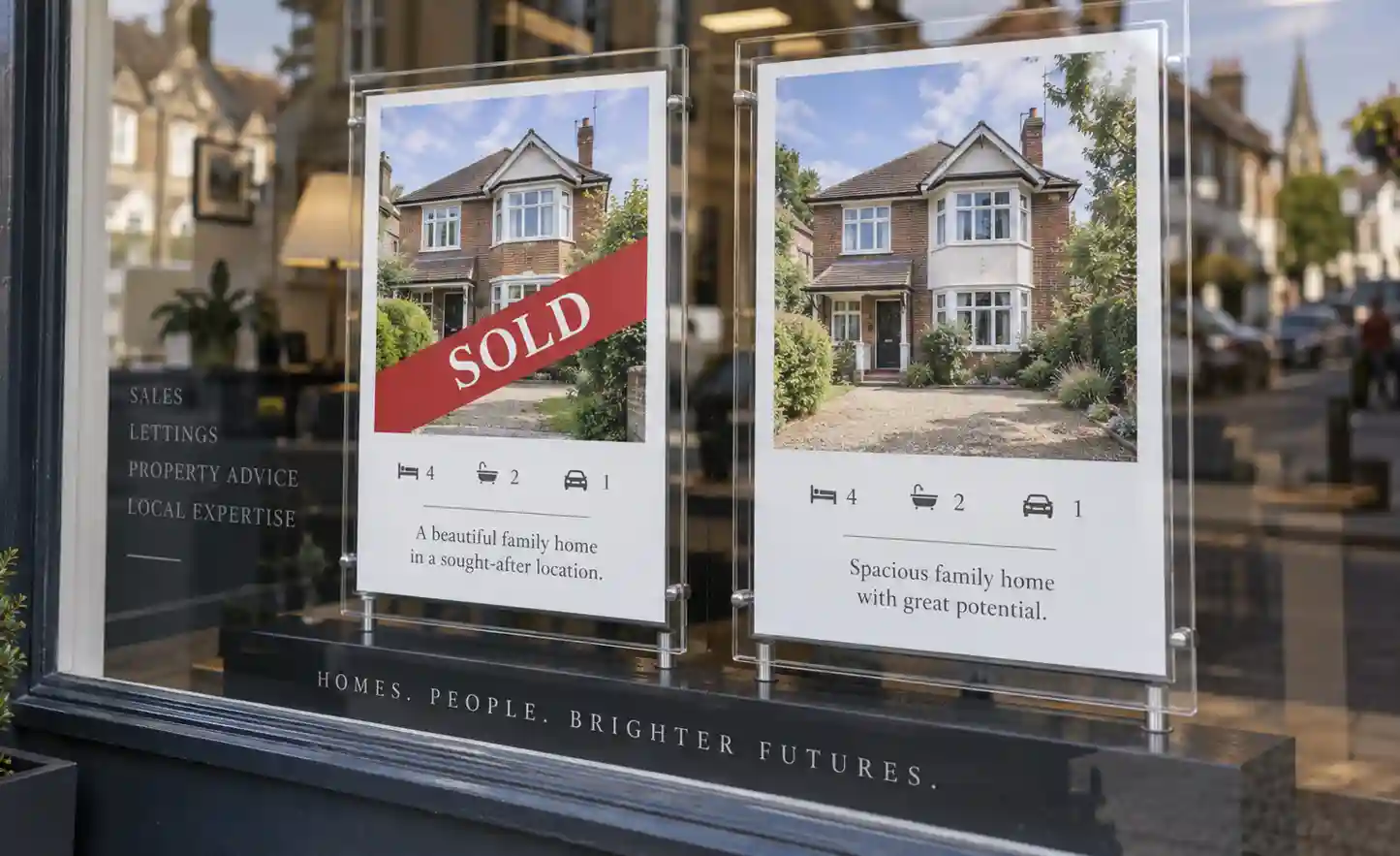
In Falkirk this summer, the average home found a buyer in eleven days. In Melton, in the East Midlands, the average was seventy-six.
Nationally, Zoopla’s analysis published in August 2026 found that the average property across Great Britain took 42 days to find a buyer in July, unchanged from a year earlier. But that apparent stability was doing a lot of work: 180 of the 363 local authorities analysed had become slower over the previous year, while 145 had become faster, sometimes only a short drive apart.
There is an important qualification to the Falkirk comparison. All ten of Zoopla’s fastest-selling areas were in Scotland, where the sales process works differently and homes are generally more affordable. The figures show how uneven the market has become; they don’t mean selling conditions are directly comparable everywhere.
And the 42 days measures roughly how long it takes to find a buyer, not the whole journey from listing a property to completing the sale.
That’s the market-level story.
The property-level story is more interesting, and it’s the one that explains why a homeowner can watch a near-identical house two streets away sell in a fortnight while their own sits with very little interest.
Usually, they’re looking at something more specific than bad luck.
“It’s always the price” is true, and also not a complete answer
There’s a kernel of real truth in the instinct that almost anything will eventually sell at the right price.
Price determines the competition a property enters. An ordinary three-bedroom house at £325,000 may look compelling beside the other homes a buyer can purchase for £325,000. Put the same house at £365,000 and buyers are comparing it with a different set of properties altogether.
The importance of getting that decision right at launch is difficult to ignore.
Rightmove’s May 2026 analysis found that properties which sold without needing an asking-price reduction took an average of 36 days to secure a buyer, compared with 127 days for those that were reduced.
That doesn’t mean reducing the price itself causes the additional delay. A property will usually have spent time failing to sell before the seller decides to cut it. What the figures do illustrate is how difficult it can be to recover the momentum lost after an over-optimistic launch.
But “it’s the price” still doesn’t fully answer the question most sellers are asking: why two houses that look genuinely similar — same postcode, same bedroom count, similar asking price — can have completely different experiences.
If price and bedroom count were the only variables, similar homes would sell at similar speeds.
They routinely don’t.
What “similar” usually isn’t
Two three-bedroom semis on the same road can appear almost interchangeable in a portal search and be very different properties to the people actually considering buying them.
One has off-street parking; the other doesn’t, and parking on that particular stretch is difficult every evening. One backs onto open land; the other onto a railway line close enough to notice immediately. One has a third bedroom that comfortably works as a bedroom; the other’s is technically a bedroom but functions, in many buyers’ minds, as an office or child’s room. One has a bright kitchen-diner overlooking the garden; the equivalent room next door feels noticeably darker.
None of those differences changes the search filter.
All of them can change what the buyer thinks the property is worth.
That’s the weakness in treating comparables too mechanically. A buyer isn’t really comparing “two three-bed semis at £340,000”. They’re comparing the experience of living in one with the experience of living in the other.
And small differences can compound. Parking alone may not decide it. Nor might the darker kitchen. Nor the smaller third bedroom. Put all three together and the supposedly similar property can start to feel like a clearly weaker purchase at the same money.
Presentation and listing quality do measurable work
The house itself is only part of what buyers encounter. Before most of them walk through the door, they encounter the listing.
The main photograph, the quality and range of the other images, an accurate floor plan and clear information about the property all influence whether somebody looking through a long set of search results decides this particular home deserves closer attention.
There is evidence behind that effect. Zoopla’s listing research, based on performance measured during 2022, found that sales listings carrying fifteen or more photographs had a 38% higher search click rate than those with five, while listings with a floor plan recorded a 9% higher search click rate than those without one.
Those figures don’t mean adding photographs will automatically make a property sell faster. They do show that the way a property is presented affects whether buyers engage with the listing in the first place.
A perfectly good house can therefore underperform simply because too few of the right buyers are being persuaded to look at it properly.
The seller’s own position can matter as well. A vendor with no onward chain, or one whose next move is already well organised, may offer greater certainty than a seller who accepts an offer and only then begins working out where they’re going.
Having found another property isn’t automatically an advantage — it can add another link to the chain — but uncertainty over the seller’s plans can add friction where buyers have other choices.
The compounding effect of time on the market itself
Once a property has been available for a while without success, time can begin working against it.
Buyers can see when listings were added or reduced, and a house that remains available while apparently comparable properties come and go naturally raises questions.
What’s wrong with it? Has a previous sale collapsed? Is the seller asking too much? Is there room to negotiate?
Those assumptions aren’t necessarily fair, but they exist.
A new listing also carries something an old one doesn’t: uncertainty. Buyers don’t initially know how much interest there will be or whether somebody else will move first. Several weeks later, with the property still available, some of that urgency has disappeared.
This is why repeated token reductions can be less effective than sellers expect. If a £450,000 property moves to £445,000 but still competes against essentially the same homes and still looks expensive beside them, very little has actually changed.
That doesn’t mean every slow property should immediately be reduced. It means time on the market is itself information. Seller and agent should be learning from what happens rather than simply waiting for a different result.
Local supply and buyer affordability set the stage before any individual listing goes live
None of these property-specific factors operates in a vacuum.
A well-presented, accurately priced home in a local market where buyers are competing for limited stock will normally have an easier time than the same property surrounded by plenty of credible alternatives.
Zoopla attributed part of the summer 2026 slowdown in many areas to higher average mortgage rates than at the start of the year, increasing buying costs and encouraging more purchasers to wait before committing.
At the same time, Rightmove reported in May that the number of homes available for sale was at its highest level for that time of year since 2015.
That combination matters.
A property’s competition isn’t simply the equivalent house next door. It’s every plausible alternative a buyer can see within their budget and search area.
When buyers have substantial choice, they can be less forgiving about an awkward bedroom, poor presentation or ambitious pricing. In a tighter market, the same compromises may be easier to accept.
This is the part a seller cannot control. A homeowner can make sensible decisions and still take longer to find a buyer in a weak local market than the owner of the same house would have done under different conditions.
What actually explains the gap
Put together, the difference between a home that sells in a fortnight and an apparently similar one that sits for months is rarely one single factor.
It’s usually a combination: a price that made sense from day one rather than one tested and corrected later, a property that genuinely outperformed its “similar” label on the things buyers notice, marketing that persuaded the right people to view it, a seller position that removed rather than added friction, and a local market that was helping or working against all of those things before the listing went live.
The pattern of interest can also tell a seller where to look.
If hardly anyone is engaging with the property online, the problem may lie with the asking price, the competition or how the listing presents the home. If buyers are looking at the details but few are arranging viewings, something isn’t converting interest into enough desire to visit. If plenty of people view but nobody offers, the problem is more likely to lie in what buyers discover when they arrive — or in whether what they find feels worth the price being asked.
Those are different problems, even though all three ultimately appear to the seller as the same thing: the house isn’t selling.
Government guidance for home sellers recommends gathering feedback from viewings and using it to decide whether problems need addressing or the asking price needs reconsidering. The useful part is looking for repetition. One buyer disliking the kitchen is taste. A succession of buyers independently raising the same objection is information.
None of that makes the familiar phrase “it’s the price” wrong.
Price remains the lever the seller controls most directly, and almost every compromise a property asks a buyer to make is ultimately judged against it. Buyers will tolerate traffic noise, an awkward bedroom, dated decoration or a smaller garden if the overall proposition makes sense at the money.
But that’s different from saying price is the only explanation.
The homes that sell quickly are usually those where the property, the presentation, the seller’s position, the local market and the price make sense together.
And where they don’t, price is often the place where that mismatch eventually has to be resolved.
Important: This article provides general information about residential property marketing and housing-market conditions, not a valuation or recommendation for a particular home. Market conditions can vary significantly by location, property type and price band. Property portals use their own datasets and methodologies when measuring selling times, so headline figures should not be treated as directly interchangeable. Sellers should use current local evidence and appropriate professional advice when setting or reviewing an asking price.

